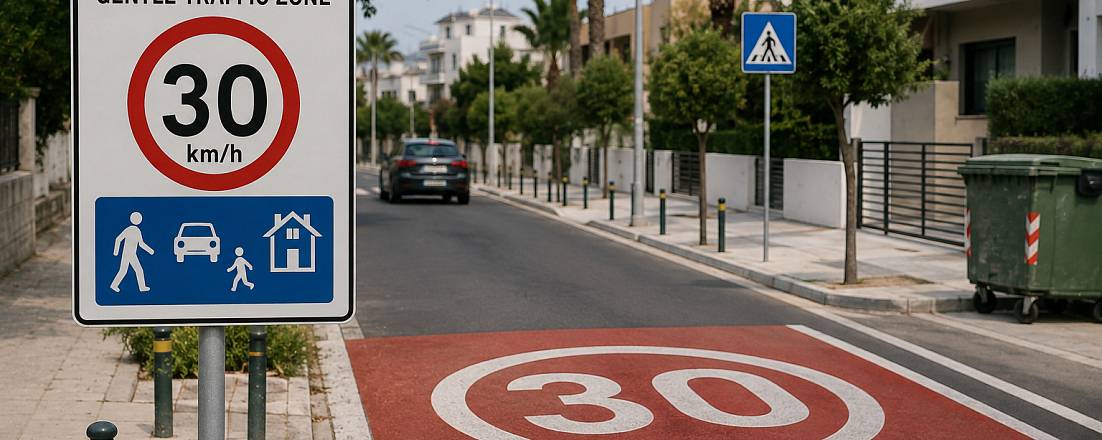
Cyprus continues to expand zones with speed limits of 20 or 30 km/h. A total of 19 areas across four districts are included in the programme. The new rules are already in force in 11 zones, while restrictions will be introduced in another eight areas in the near future. The measures are being implemented as part of a policy aimed at improving road safety. The relevant zones are approved by special orders of the Ministry of Transport following consideration of proposals submitted by local authorities.
According to the Department of Public Works, the purpose of these zones is not limited to reducing vehicle speeds. The authorities also aim to reduce the number of accidents, cut transport emissions and create a more comfortable urban environment for pedestrians, cyclists and other vulnerable road users.
Where speed restrictions are already in force in Cyprus
The new rules have been introduced most extensively in areas of Nicosia and Limassol. In the capital, the restrictions apply to several historic and residential districts. A reduced-speed regime is in force within the old city of Nicosia, inside the Venetian walls. Similar rules apply in the historic centres of Kaimakli and Pallouriotissa, as well as in the Agioi Omologites area. A separate zone has also been created in Lykavitos, between Kallipoleos, Makariou, Digeni Akrita and Ethnikis Frouras avenues.
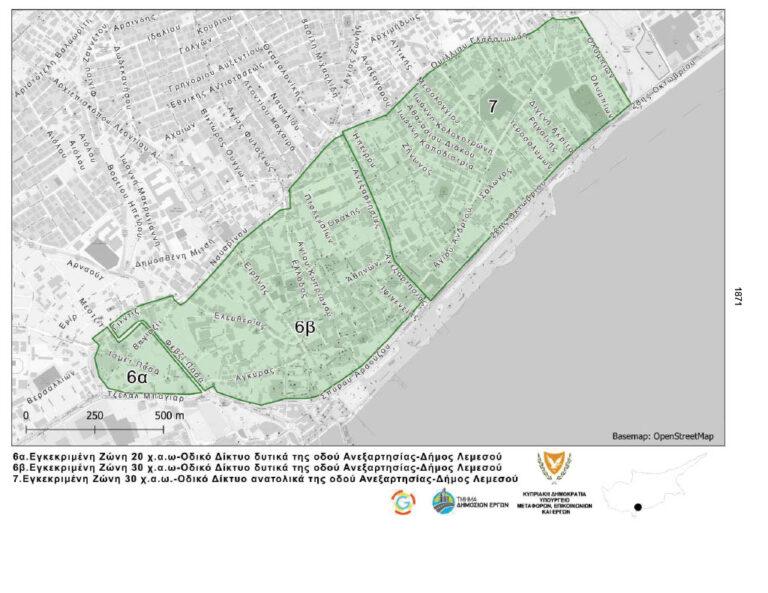
In Limassol, the restrictions cover several parts of the urban area. The programme includes streets to the west and east of Anexartisias Avenue, as well as part of the Agios Nektarios parish. This area is located between Archbishop Makarios III Avenue and Fereou and Milona streets. The speed limit also applies to the old centre of Kato Polemidia. In the Municipality of Amathus, Anikodomiseos Street and the surrounding roads in the Agios Athanasios area have been included in the relevant zone.
In the Paphos district, a reduced-speed regime has already been introduced in the traditional centre of Geroskipou. These measures therefore mainly concern densely populated residential areas, historic centres, places with high pedestrian activity and busy urban traffic.
Why Cyprus is reducing speed limits to 20–30 km/h
Lower speed limits form part of Cyprus's broader policy to reduce road fatalities and the severity of traffic accidents. The issue is particularly relevant in urban areas. According to the cited data, cities account for 63.5% of road fatalities and 80% of people seriously injured in traffic accidents.
Reducing vehicle speed lowers not only the likelihood of a serious accident but also the severity of the consequences of a collision. This is why 20 and 30 km/h zones are primarily introduced in areas where vehicles regularly interact with pedestrians and cyclists. In addition to improving safety, these zones serve other purposes. Lower speeds can help reduce noise and emissions, while making streets more comfortable for walking and everyday travel.
The creation of traffic-calming zones is included in Cyprus's Strategic Road Safety Plan for 2021–2030. The authorities view the expansion of such areas as one of the tools for improving overall safety on urban streets.
How an area becomes a 20 or 30 km/h zone
The introduction of a reduced speed limit is not automatic. The process begins at local level: a proposal to create such a zone must first be considered and approved by the relevant municipal council. The project is then submitted to the technical committee of the Central Body for Resolving Traffic Problems at the Department of Public Works. Approval from the Chief of Police is also required for implementation.
The municipality must also take into account the views of people directly affected by the changes. Consultations are therefore held with local residents and businesses. Once all the necessary procedures have been completed, the Ministry of Transport formally approves the zone by issuing an order.
The authorities expect the number of such areas in Cyprus to increase gradually. The Department of Public Works is awaiting new applications from local authorities. Several municipalities have already submitted documents to obtain funding under a special subsidy scheme for projects creating 20 and 30 km/h speed-limit zones.
For drivers, this means that familiar speed limits in certain parts of the island will gradually change. Particular attention should be paid to road signs when entering historic centres, residential neighbourhoods and other areas where traffic-calming measures are being introduced, as the signs determine the speed limit that applies on each specific road section.
A wide selection of cars is available on the DOMCar portal.
Photos: DOM, Pixabay